Narcissists and “Bunny Boiler Memento Boxes”
Narcissists and “Bunny Boiler Memento Boxes”
This applies to both male and female Narcissists…
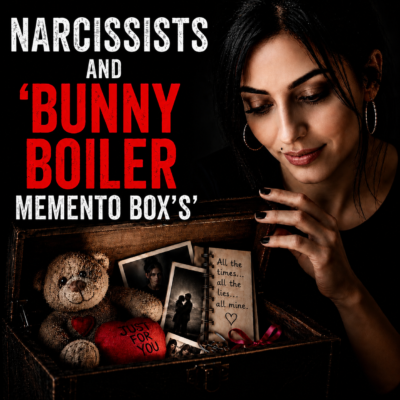
I call them “Bunny Boiler Memento Boxes” — those boxes containing reminders, letters, photographs and keepsakes from previous relationships that, in some circumstances, can start to feel less like innocent memories and more like a collection of emotional trophies.
Let me be clear from the beginning: keeping things from an old relationship does not make somebody a narcissist. Most of us have photographs, letters or objects from our past. They are part of our history.
What I am talking about is something very different: when those objects appear to remain emotionally significant, are repeatedly preserved across relationships, or — more worryingly — are displayed or used in a way that causes distress to the current partner.
I can only explain this properly by giving a personal example.
My ex-wife had a box containing mementos from previous relationships, including items from both her first and second marriages (yes, I was the third). Among them was the last handwritten letter her first husband had ever sent her, dating back to the early 2000s.
Why keep it?
Perhaps there was a perfectly ordinary sentimental explanation. But given other things I experienced within the relationship, I personally came to see the collection differently.
To me, they felt like trophies.
A physical archive of previous relationships, previous partners and previous emotional attachments.
But the box wasn’t actually the part that affected me most.
What I found considerably more disturbing was that when we were together, she kept large framed photographs of herself with her second husband in our matrimonial bedroom, right by the bed.
Think about that for a moment.
You’re trying to build a marriage and a future with somebody while large photographs celebrating their previous marriage remain beside the bed you share.
I repeatedly wanted them moved.
She refused.
Eventually, after around two years, I reached the point where I could no longer tolerate what I experienced as the mental and emotional torment of having them there. I removed the pictures myself and threw them into a skip.
Some people might say I shouldn’t have done that.
Fair enough.
But unless you’ve lived inside a relationship where something you have repeatedly explained is hurting you continues regardless, it can be difficult to understand the cumulative psychological effect.
What made the situation even more troubling for me was an explanation she gave at a later date.
Her words to me were:
“I hurt every day, why shouldn’t you.”
That sentence has stayed with me.
Because suddenly the question wasn’t simply:
Why would somebody want photographs of an ex-husband beside their marital bed?
The bigger question became:
Why knowingly continue something when you understand that it is hurting your current partner?
And that, for me, is where this subject becomes relevant to narcissistic awareness.
It isn’t really about photographs.
It isn’t really about letters.
And it isn’t really about a box.
It is about empathy, boundaries, emotional power and intent.
There is an enormous difference between accidentally upsetting somebody and knowing that something hurts them but continuing anyway.
There is also a difference between privately preserving your history and making a previous relationship an unavoidable presence within your current one.
This is why I use the tongue-in-cheek phrase “Bunny Boiler Memento Box” (a “bunny boiler” is an informal, common term for someone—usually an ex-partner—who becomes obsessively possessive, jealous, intrusive or vindictive after a romantic relationship ends, originating from the film “Fatal Attraction”).
When I look back, I question whether some of those objects represented nostalgia, unresolved attachment, validation, emotional trophies, a way of retaining ownership over previous relationships — or simply an inability to let the past remain in the past.
I cannot know another person’s internal motivation with certainty.
What I can describe is what I witnessed, what was said to me and how those behaviours affected me.
And when somebody effectively communicates:
“I am hurting, therefore you should hurt too,” that should concern anyone.
Healthy relationships require empathy.
They require compromise.
They require respect for reasonable boundaries.
And they require some consideration for the emotional wellbeing of the person you’re supposed to love.
For me, keeping photographs from the past wasn’t the real red flag.
Knowing those photographs were causing me genuine emotional distress and still refusing to move them was bad enough. But the explanation that followed was, for me, far more disturbing: “I hurt every day, why shouldn’t you?”
And what exactly was this supposed “hurt” that apparently justified deliberately hurting me?
She was unhappy about somewhere I had once worked — a job I had left seven years before we had even met.
Think about that for a moment. Something that had happened seven years before she entered my life was being used as justification for keeping large framed photographs of herself with a former husband beside our matrimonial bed, despite knowing how much distress their presence was causing me.
That is the part I found particularly chilling. It wasn’t simply sentimentality or an inability to let go of old photographs. Her own words appeared to frame my distress as punishment: I believe I hurt, therefore you should hurt too.
To me, that crossed a very different line. When somebody knows something is hurting their partner, has the simplest opportunity to stop it, deliberately refuses to do so and then effectively explains that your suffering is deserved because they believe they are suffering, it can become emotionally punitive and controlling behaviour.
It was calculated cruelty as I experienced it: your pain becomes the point.
This is one of the behaviours I now associate with narcissistic relationship dynamics — not because keeping photographs automatically makes somebody a narcissist, but because of the apparent lack of empathy, retaliation, punishment and deliberate continuation of something known to cause emotional distress.
Looking back, the photographs weren’t the most worrying part.
The justification was.
Very hurtful.
Very worrying.
And, in my personal experience and opinion, very consistent with the narcissistic behaviours I experienced within that relationship.
Sometimes after leaving a difficult relationship, you look back at individual events that seemed confusing at the time and suddenly see how they fitted into a much larger pattern.
The box was only a box.
The photographs were only photographs.
The behaviour surrounding them was what mattered…narcissistic.
Side Note: When the Photographs Tell a Very Different Story
There is another part of this subject that I feel is particularly relevant when talking about mementos, photographs and an apparent obsession with preserving the past.
Sometimes the photographs don’t just preserve the memories.
Sometimes they expose the lies surrounding them.
In 2025, my wife and I visited the Isle of Wight, somewhere I had previously lived. While we were there, she told me about a hotel in Shanklin where she said she had previously stayed with her mother and her two daughters.
She wanted to find it.
So, being her husband and believing what I had been told, I drove around Shanklin for approximately an hour trying to locate this particular hotel for her.
Eventually, we found it.
She appeared deeply nostalgic. She reminisced about the place and took plenty of photographs. I thought I was watching my wife revisit memories of a family holiday with her mother and daughters.
That wasn’t the full story I later discovered.
After we separated, I came across old photographs that had been in storage. Those photographs showed her at the same location with her second husband.
This was despite me previously being led to believe that she had never been there with him.
The photographs told a very different story.
And that is what made this so disturbing for me.
I had spent around an hour driving my wife around Shanklin, trying to find somewhere that apparently carried significant memories of a previous husband, while believing I was helping her revisit memories involving her mother and daughters.
I find that incredibly disrespectful.
If someone wants to revisit a location connected to a previous marriage, that is their decision. But give your current partner the truth and allow them to decide whether they want to participate.
Don’t rewrite the history and unknowingly make your current partner the chauffeur for a trip down memory lane involving your previous husband.
For me, that is where this becomes much more than somebody simply keeping a few old photographs.
It raises a much bigger question: why lie about who you were there with?
Why specifically create a different explanation for why the location mattered?
And why involve your current husband in finding and photographing somewhere connected to a former husband without being transparent about that connection?
The irony is that photographs ultimately exposed what words had concealed.
This is particularly relevant to my wider discussion about narcissistic behaviours because repeated lying, rewriting history, withholding relevant information and manipulating another person’s understanding of events can become extremely psychologically damaging within a relationship. None of these behaviours alone diagnoses Narcissistic Personality Disorder, but when experienced as part of a broader pattern, they can leave the other person wondering how many supposedly innocent memories and explanations were actually something completely different.
And there is another uncomfortable element.
She wasn’t simply looking at an old photograph in private.
I was unknowingly being brought into the memory.
I was driving around searching for the location.
I helped find it.
I stood there while new photographs were taken.
All while apparently being given a completely different account of why that place held such significance.
That is what I find so unpleasant about it.
It wasn’t about being jealous of an ex-husband. Everybody has a history. Previous marriages, relationships, holidays and memories don’t magically disappear because somebody meets somebody new.
The issue was deception.
Had I known the truth, I could have made my own choice.
Instead, I believe that choice was taken away from me because I wasn’t given the information necessary to understand what I was actually participating in.
And when I later found those old photographs, there was something particularly sad about the discovery.
The evidence had apparently been sitting there all along.
Stored away among the other memories.
A photograph can capture a moment.
A collection of photographs can preserve a past.
But sometimes a photograph does something else entirely: it exposes a story that simply doesn’t match the one you were told.
And when enough of those moments begin appearing within a relationship, you eventually stop asking why one particular story wasn’t true.
You start wondering how much of the relationship you were living was based on stories that weren’t true either.
The biggest mistake of my life was marrying an emotional vampire. One of the best decisions of my life was finally making the decision to walk away.
And I did.
But leaving wasn’t the end of it. What followed was an all-too-familiar pattern of behaviour: the smear campaign, the rewriting of events and false accusations.
That part of the story deserves a post of its own — and I’ll be exploring it shortly.
When the pattern becomes visible, the behaviour becomes remarkably easy to recognise.
Textbook. Typical. Predictable.
Disclaimer:
This post describes my own personal experiences, recollections, opinions and interpretation of events and is shared for the purposes of discussion, education and raising awareness of narcissistic and unhealthy relationship behaviours. References to “narcissistic” behaviour should not be interpreted as a clinical diagnosis of any individual unless such a diagnosis has independently been made by an appropriately qualified professional. The factual events and communications referred to in my personal account are matters that I state I can substantiate, where relevant, through various forms of electronic, digital and other retained evidence. I am sharing information about my own experiences voluntarily as an expression of my personal perspective and in the exercise of my freedom of expression. Readers should make their own judgments and should not use this post to diagnose any individual.